
Back to products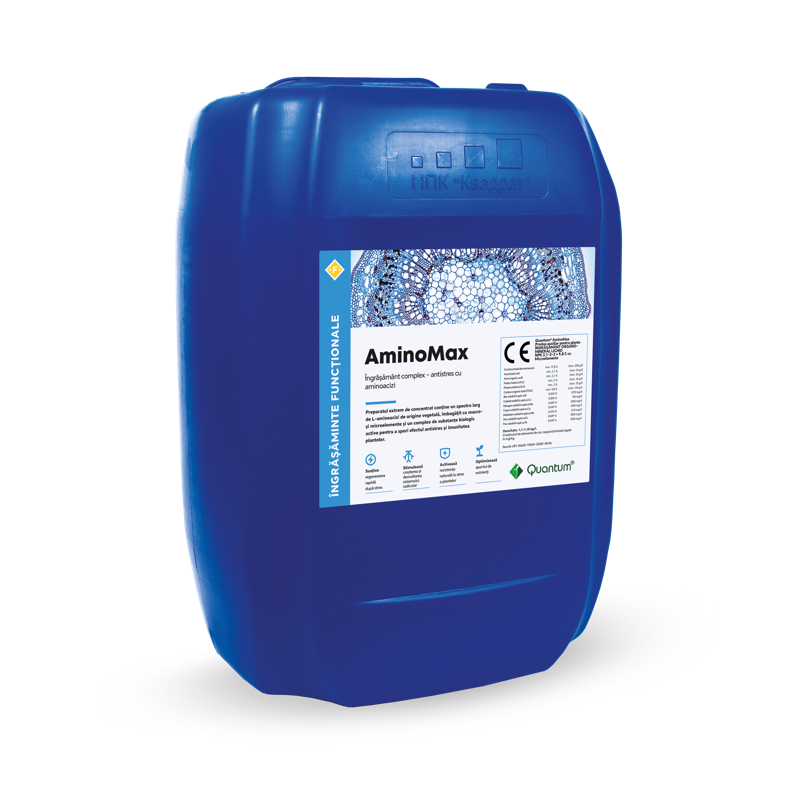
Functional Fertilizers
Quantum® AminoMax
Complex anti-stress fertilizer with amino acids for foliar plant nutrition. Contains a balanced set of macro- and microelements, L-amino acids of plant origin and a complex of biologically active substances.
CHEMICAL COMPOSITION AND PROPERTIES:
| Element | % (w/w) | g/L |
|---|---|---|
| Amino acids | 17.8% | 200 g/L |
| N | 2.1% | 24 g/L |
| P₂O₅ | 2.0% | 22 g/L |
| K₂O | 2.0% | 23 g/L |
| B | 0.024% | 270 mg/L |
| Fe | 0.049% | 550 mg/L |
| Zn | 0.049% | 550 mg/L |
| Cu | 0.049% | 550 mg/L |
| Mn | 0.049% | 550 mg/L |
| Mo | 0.010% | 110 mg/L |
| Co | 0.004% | 50 mg/L |
Characteristics
| pH | 4.0–5.5 | |
| Density | 1.10–1.15 kg/L | |
Enriched with a complex of biologically active substances.
ACTION AND EFFECT:
- The highly concentrated preparation contains a wide range of amino acids, enriched with macro- and microelements, humic substances, organic acids and phytohormones for: promoting root system growth and development; overcoming stress, especially in drought and high temperature conditions; stimulating natural plant protection against pathogens; increasing seedling survival rate after transplantation.
SEED TREATMENT.
Application rate: 1–2 liters per ton of cereal, legume, industrial and vegetable seeds.
FERTIGATION: The product is applied 2–4 times during the growing season at a rate of 1.0–5.0 L/ha. Filter cleaning of the irrigation system is recommended before and after application due to the presence of organic components. Post-transplant seedling fertilization.
watering with a 0.5–0.7% solution (0.5–0.7 liters per 100 liters of water).
AS ADJUVANT AND ANTI-STRESS AGENT.
in tank mix with insecticides and fungicides, the product is used at a rate of 0.2–0.7 L/ha. Combining fertilization with herbicide treatment in early growth stages is not recommended.
Recommended application rates for Quantum® AminoMax foliar application
Field crops and vegetables
Corn
3–5 leaves (BBCH 13-15)0.5–1.0 L/ha
6–8 leaves (BBCH 16-18)0.5–1.0 L/ha
tassel drop (BBCH 42-59)0.5–1.0 L/ha
Sunflower
2–3 leaf pairs (BBCH 14-16)0.5–1.0 L/ha
5–6 pairs (BBCH 30-33)0.5–1.0 L/ha
budding (BBCH 51-55)0.5–1.0 L/ha
Rapeseed
spring vegetation (BBCH 21-39)0.5–1.0 L/ha
budding (BBCH 50-61)0.5–1.0 L/ha
seed formation (BBCH 71-79)0.5–1.0 L/ha
Soybean, peas
3–5 triple leaves (BBCH 14-16)0.5–1.0 L/ha
budding–early flowering (BBCH 51-61)0.5–1.0 L/ha
grain formation (BBCH 71-79)0.5–1.0 L/ha
stem development (BBCH 21-39)0.5–1.0 L/ha
Potatoes
budding–start of wilting and tip drying (BBCH 51-97) (7–10 day intervals), full flowering–ripening (BBCH 64-89) (7–10 day intervals)0.5–1.0 L/ha
Tomatoes, peppers, eggplants
leaf growth and development (BBCH 13-29) (7–10 day intervals), fruiting (BBCH 71-89) (7–10 day intervals)0.5–1.0 L/ha
Cucumbers
4–6 true leaves (BBCH 14-16)0.5–1.0 L/ha
root growth (BBCH 41-49) (7–10 day intervals)0.5–1.0 L/ha
Carrots
root growth (BBCH 41-49) (7–10 day intervals)0.5–1.0 L/ha
Onion, garlic
start of formation–end of bulb filling (BBCH 41-49) (7–10 day intervals)0.5–1.0 L/ha
Cabbage
head formation (BBCH 41-49) (7–10 day intervals)0.5–1.0 L/ha
Fruit and berry crops
Stone fruits
petal fall (BBCH 67-69)0.1–0.2 L/100 L
Grapes
flowering–berry growth (BBCH 61-79)0.1–0.2 L/100 L
Currants, raspberry
flowering (BBCH 61-69)0.2–0.3 L/100 L
Strawberries
end flowering–harvest (BBCH 65-89)0.2–0.3 L/100 L
Nuts
flowering (BBCH 61-69)0.1–0.2 L/100 L
fruit growth (BBCH 71-89)0.1–0.2 L/100 L
| Recommended application rates for Quantum® AminoMax foliar application | ||
|---|---|---|
| Crop | Growth & development stage | Application rate |
| Field crops and vegetables | ||
| Corn | 3–5 leaves (BBCH 13-15) | 0.5–1.0 L/ha |
| 6–8 leaves (BBCH 16-18) | 0.5–1.0 L/ha | |
| tassel drop (BBCH 42-59) | 0.5–1.0 L/ha | |
| Sunflower | 2–3 leaf pairs (BBCH 14-16) | 0.5–1.0 L/ha |
| 5–6 pairs (BBCH 30-33) | 0.5–1.0 L/ha | |
| budding (BBCH 51-55) | 0.5–1.0 L/ha | |
| Rapeseed | spring vegetation (BBCH 21-39) | 0.5–1.0 L/ha |
| budding (BBCH 50-61) | 0.5–1.0 L/ha | |
| seed formation (BBCH 71-79) | 0.5–1.0 L/ha | |
| Soybean, peas | 3–5 triple leaves (BBCH 14-16) | 0.5–1.0 L/ha |
| budding–early flowering (BBCH 51-61) | 0.5–1.0 L/ha | |
| grain formation (BBCH 71-79) | 0.5–1.0 L/ha | |
| stem development (BBCH 21-39) | 0.5–1.0 L/ha | |
| Potatoes | budding–start of wilting and tip drying (BBCH 51-97) (7–10 day intervals), full flowering–ripening (BBCH 64-89) (7–10 day intervals) | 0.5–1.0 L/ha |
| Tomatoes, peppers, eggplants | leaf growth and development (BBCH 13-29) (7–10 day intervals), fruiting (BBCH 71-89) (7–10 day intervals) | 0.5–1.0 L/ha |
| Cucumbers | 4–6 true leaves (BBCH 14-16) | 0.5–1.0 L/ha |
| root growth (BBCH 41-49) (7–10 day intervals) | 0.5–1.0 L/ha | |
| Carrots | root growth (BBCH 41-49) (7–10 day intervals) | 0.5–1.0 L/ha |
| Onion, garlic | start of formation–end of bulb filling (BBCH 41-49) (7–10 day intervals) | 0.5–1.0 L/ha |
| Cabbage | head formation (BBCH 41-49) (7–10 day intervals) | 0.5–1.0 L/ha |
| Fruit and berry crops | ||
| Stone fruits | petal fall (BBCH 67-69) | 0.1–0.2 L/100 L |
| Grapes | flowering–berry growth (BBCH 61-79) | 0.1–0.2 L/100 L |
| Currants, raspberry | flowering (BBCH 61-69) | 0.2–0.3 L/100 L |
| Strawberries | end flowering–harvest (BBCH 65-89) | 0.2–0.3 L/100 L |
| Nuts | flowering (BBCH 61-69) | 0.1–0.2 L/100 L |
| fruit growth (BBCH 71-89) | 0.1–0.2 L/100 L | |